
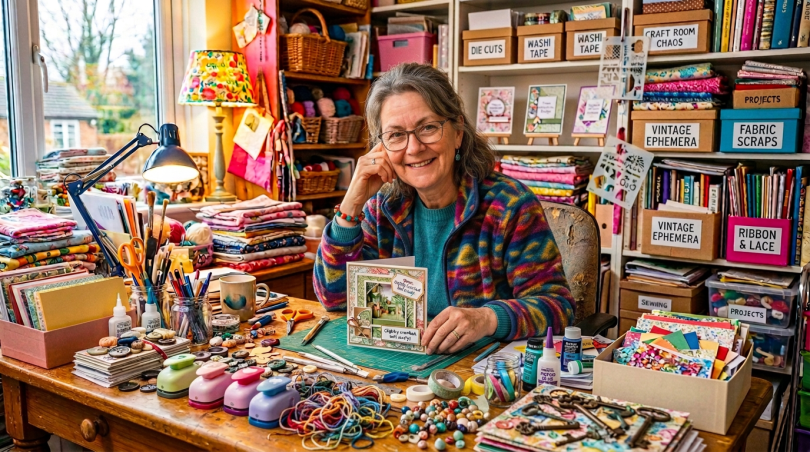
Hello there, my crafty chums!
Now, before we get started, I should probably warn you that today’s blog post might make for some uncomfortable reading. Not because I’m about to reveal some terrible scandal involving a well-known craft celebrity, a missing embossing folder and a suspiciously sticky tube of glitter glue, but because I thought it might be interesting to have a little chat about some of the things that we crafters know to be true but would rather not admit.
You see, crafting is wonderful. It’s creative, therapeutic, rewarding and, at times, downright magical. We can take a few sheets of paper, some glue and a handful of embellishments and turn them into something that brings a smile to somebody’s face.
However, beneath all those beautifully coordinated cardstock collections and perfectly organised ribbon racks lies a world of secrets, questionable financial decisions and enough unused crafting supplies to keep a small country occupied until the next millennium.
So, put the kettle on, grab yourself a biscuit (or three) and prepare for a little self-reflection.
Don’t worry. I’m including myself in this little interrogation.
Right then, shall we…?
1. We Have Absolutely No Idea What We Own
Let’s start with a confession. How many times have you returned home from a craft shopping expedition, proudly unpacked your latest purchases, only to discover that you already own exactly the same thing?
Not something similar. Not a slightly different version. The EXACT same thing.
Perhaps it’s a stamp set, a roll of ribbon or a particularly fetching shade of ink. You bought it because you loved it, brought it home and carefully placed it somewhere safe. So safe, in fact, that it might as well have been deposited in a Swiss bank vault.
Six months later, there you are, buying it again.
Of course, the sensible solution would be to catalogue everything we own, but that would mean actually acknowledging just how much stuff we have accumulated.
And frankly, I don’t think any of us are emotionally prepared for that.
2. Some Paper Is Simply Too Beautiful to Use
Ah yes. The sacred paper collection.
Every paper crafter has one. That special collection of papers that we bought because they were absolutely gorgeous. The colours, the patterns, the texture and, in some cases, even the smell!
We couldn’t possibly leave them on the shop shelf.
But here’s the problem – they’re too nice to cut.
So, instead of using them to create something beautiful, we lovingly stroke them, admire them, occasionally fan them out on the desk and then return them to their protective packaging.
And woe betide anyone who suggests cutting into one of those precious twelve-by-twelve sheets!
The irony, of course, is that the designer spent months creating that paper specifically so that somebody could make something with it. Meanwhile, we’re treating it like an original Rembrandt, lol!
I wonder how many beautiful papers will spend their entire existence being admired inside a plastic wallet?
A moment’s silence for all those uncut masterpieces, please.
3. Our Craft Stash Might Actually Be Stifling Our Creativity
Now this one might sting a little.
We’ve all convinced ourselves that having more supplies means having more creative possibilities. After all, if we own every colour of ink, every possible shape of cutting die and enough cardstock to wallpaper Buckingham Palace, surely we’ll never be short of inspiration?
Except that’s not quite how it works, is it?
Sometimes, having too much choice makes it almost impossible to decide what to create. We spend forty minutes looking for a particular stamp, another twenty deciding which paper to use and then discover that the glue we wanted has dried up.
By the time we’ve found everything, it’s time to make dinner.
And so, another productive crafting session comes to an end without so much as a single piece of paper being cut.
Perhaps creativity doesn’t always flourish when we have everything at our fingertips. Perhaps it sometimes needs a few limitations.
Or perhaps I just need to tidy my craft room.
No, no. Let’s not get carried away.
4. Crafting Is Not a Cheap Hobby (Despite What We Tell Ourselves)
There’s a certain unspoken agreement amongst crafters that we should NEVER calculate the total value of our craft stash.
EVER.
We might cheerfully tell somebody that a handmade card costs very little to produce. After all, it’s just a bit of paper, some glue and a few embellishments.
Naturally, we’re choosing to ignore the £200 die-cutting machine, the £80 collection of stamps, the £50 worth of inks and the small fortune spent on tools that were absolutely essential at the time.
And then there’s the storage.
Good grief, the storage!
We buy more supplies, realise we have nowhere to put them, purchase additional storage furniture and then celebrate the newly available space by buying more supplies.
It’s a magnificent business model.
For the craft retailers, anyway.
Still, when somebody asks how much we’ve spent on crafting over the years, there’s only one sensible response.
“I’d rather not say.”
Preferably whilst looking thoughtfully into the distance.
5. We’re Often Better at Shopping for Crafts Than Actually Crafting
Ooh, here’s a controversial one!
I suspect that for some of us, the excitement of discovering and buying new crafting products has become almost as enjoyable as the act of making something.
A new collection launches, a television demonstration catches our attention or somebody shares an exciting product in a Facebook group and suddenly we’re convinced that this particular item will revolutionise our creative lives.
We order it, eagerly await its arrival, unpack it, admire it and then…
Well.
Sometimes that’s as far as things get.
The next exciting thing has already appeared.
There’s absolutely nothing wrong with enjoying craft shopping. It’s part of the fun. But I do wonder whether the constant stream of new products sometimes distracts us from the wonderful things we could be making with the supplies we already have.
Which brings me neatly to another uncomfortable truth.
6. We Have Enough Unfinished Projects to Open a Museum
Hands up if you’ve ever started a project, become distracted by another idea and promised yourself that you’d finish the original one later.
Yes, I thought so.
The half-knitted jumper. The scrapbook that’s missing three pages. The embroidered picture that’s been sitting in its hoop since 2017. The card that only needs a sentiment before it’s finished.
They’re all waiting patiently for us to return.
And of course, we WILL return.
One day.
Probably.
The trouble is, starting something new is exciting. Finishing something that’s been sitting on a shelf for eighteen months can feel suspiciously like doing homework.
Perhaps we should stop calling them unfinished projects and start referring to them as our creative archive.
Sounds much more impressive, doesn’t it?
7. Selling Handmade Crafts Is Much Harder Than People Think
Now, let’s venture into slightly more serious territory.
How many times have you heard somebody say, “Oh, you should sell those! You’d make a fortune!”
It’s usually said with the very best of intentions, but the reality of turning a creative hobby into a profitable business is rather different.
For starters, many non-crafters simply don’t understand the time, skill and effort that goes into making something by hand. They see a beautiful handmade card and compare its price to something mass-produced in a supermarket.
They don’t see the design process, the materials, the equipment, the packaging, the photography, the marketing or the three attempts that ended up in the bin.
And then there are the markets themselves. Some are so overcrowded with similar products that standing out can be extraordinarily difficult.
You might spend four hours making something wonderful, only to have a potential customer tell you that they could buy something similar for £2.50.
Lovely.
Of course, what you’re really selling isn’t just the object. It’s your creativity, experience, craftsmanship and time.
Unfortunately, convincing everybody else of that can be rather exhausting.
8. Turning Your Hobby Into a Job Can Take the Joy Out of It
I think this is something that deserves far more discussion, particularly amongst those who dream of making their living through crafting.
When crafting is a hobby, you can create whatever you fancy, whenever you fancy. If you’re not feeling particularly inspired, you can simply put everything away and try again tomorrow.
When it’s your job, however, things change.
Suddenly there are deadlines, customer expectations, marketing commitments, invoices, technical problems and the constant pressure to produce something new.
You might not feel remotely creative, but that tutorial still needs filming. The customer order still needs posting. The article still needs writing.
And let’s not forget the joy of spending three hours editing a video about a project that took twenty minutes to make.
Ask me how I know.
Don’t get me wrong. Making a living doing something creative can be enormously rewarding, but it isn’t quite the endless crafting holiday that people sometimes imagine.
Sometimes your passion becomes your profession.
And sometimes your profession starts behaving suspiciously like a job.
Funny that.
9. Social Media Crafting Is Not Real Life
Ah, the wonderful world of online crafting.
Beautifully organised workspaces, immaculate white desks, carefully arranged supplies and creators who somehow manage to complete complicated projects without getting a single blob of glue on their fingers.
Marvellous, isn’t it?
Meanwhile, back in the real world, there’s a bin overflowing with paper scraps, the dog has wandered off with a foam blending tool and you’re trying to remove double-sided tape from your favourite trousers.
The thing is, social media usually shows us the finished result, not the seventeen things that went wrong along the way.
We see the beautiful card, not the one that was glued together backwards.
We see the wonderful quilt, not the hours spent unpicking a seam.
We see the perfect resin creation, not the failed experiments that preceded it.
There’s nothing wrong with presenting our work beautifully. After all, we want people to appreciate what we’ve created.
But perhaps we should remember that a beautiful photograph doesn’t necessarily represent a beautiful afternoon.
Sometimes creativity is messy, frustrating and accompanied by language that would make a sailor blush.
And that’s perfectly normal.
10. Crafting Is Good for the Mind, But Not Always for the Body
There’s no denying that crafting can be a wonderful way to relax, unwind and escape the stresses of everyday life. Research into creative activities has also identified potential benefits for mood and wellbeing.
However, our bodies don’t always appreciate our enthusiasm.
Hours spent hunched over a desk, peering at tiny details, gripping tools or operating machinery can take their toll. Neck pain, sore shoulders, aching wrists and tired eyes are familiar complaints for many dedicated makers.
And how many of us have become so absorbed in a project that we’ve completely forgotten to move for several hours?
You stand up and suddenly discover that your knees have apparently aged twenty years since you sat down.
Still, the card looks lovely.
Perhaps we should all make a little more effort to look after the bodies that allow us to enjoy our favourite pastime.
Take regular breaks, stretch occasionally, adjust your working position and remember that no handmade birthday card is worth developing a permanent crick in your neck.
Even if it does have a particularly complicated pop-up mechanism.
11. Craft Snobbery Is Alive and Well
Ooh, now here’s a subject that could cause a few raised eyebrows.
Crafting is supposed to be an inclusive, welcoming hobby, and for the most part I genuinely believe that it is.
However, let’s not pretend that a little snobbery doesn’t occasionally creep into proceedings.
There are those who insist that only certain brands are worth buying. Those who look down on inexpensive supplies. Those who believe that handmade means doing absolutely everything by hand and those who think that using a digital cutting machine somehow makes a project less creative.
Then there’s the opposite argument, where people are criticised for spending money on premium products when cheaper alternatives are available.
It’s all rather silly, really.
There’s nothing wrong with appreciating good-quality tools, nor is there anything wrong with working within a modest budget. There’s also an important difference between affordable alternatives and counterfeit products that copy somebody else’s designs.
Surely what matters most is what somebody creates, rather than how much they paid for the equipment used to create it?
A beautiful project made with bargain-bin supplies is still a beautiful project.
And a dreadful project made with £500 worth of premium equipment is still…
Well.
Let’s just call it an experimental piece.
12. If You Share Your Creations Online, Somebody Will Eventually Copy Them
This is another difficult subject, particularly for those who make their living from their creative work.
Sharing projects online can be enormously rewarding. It inspires others, encourages creativity and helps build wonderful communities of like-minded people.
However, once something is shared publicly, there’s always a possibility that somebody will attempt to recreate it.
Now, there’s an important distinction to make here.
Taking inspiration from somebody else’s work, learning a technique or following a tutorial that’s been freely shared for that purpose is a perfectly normal part of crafting.
After all, we’ve all learnt from somebody.
But directly copying another creator’s original designs, reproducing their work for commercial gain or presenting somebody else’s ideas as your own is a rather different matter.
And for somebody whose livelihood depends on selling their designs, that can have very real consequences.
Not every similar-looking project is theft, of course, and no single crafter owns every possible way of folding a piece of cardstock.
Nevertheless, I do think we could all do a little better at acknowledging the people whose creativity inspires us.
A simple credit costs nothing.
Unlike the three hundred pounds’ worth of equipment you needed to recreate the project.
Sorry. Couldn’t resist.
13. We Sometimes Feel Guilty for Not Crafting
Here’s something I don’t think we talk about nearly enough.
When you’ve invested a considerable amount of time, money and space into a hobby, there’s a strange sense that you ought to be doing it all the time.
You look at your craft room, see all those wonderful supplies and think, “I really should be making something.”
But perhaps you’re tired. Perhaps you’re busy. Perhaps you’re simply not in the mood.
And suddenly, the hobby that was supposed to help you relax becomes another thing on your increasingly long list of obligations.
It’s rather ridiculous when you think about it.
We don’t buy a television and then feel guilty for not watching it every evening. Well, most of us don’t.
Why should crafting be any different? Creativity isn’t something that can always be switched on like a kitchen light.
Sometimes the best thing you can do for your creative enthusiasm is to leave it alone for a little while. The glitter will still be there when you return.
Trust me. Glitter is ALWAYS there!
14. Crafting Can Be a Little Lonely
This might sound strange, particularly when you consider how many crafting groups, online communities, workshops and events exist these days.
But crafting can be quite a solitary activity.
Many of us spend hours working alone, happily engrossed in our own little creative worlds. For some, that peace and quiet is precisely what makes the hobby so enjoyable.
For others, though, it can occasionally feel rather isolating, particularly when friends and family don’t share the same enthusiasm.
It’s difficult to explain the excitement of finally achieving a perfect stamped impression to somebody who thinks a stamping platform is something found at a railway station.
This is one of the reasons I think crafting communities are so important. Finding people who understand why you’re excited about a new embossing folder, a successful bit of machine cutting or a particularly pleasing colour combination can make a wonderful difference.
And sometimes it’s just nice to have somebody who understands why you own seventeen pairs of scissors.
Even if you’re not entirely sure yourself.
15. We Probably Spend More Time Organising Our Craft Supplies Than Using Them
Now, I do love a good storage solution.
There’s something deeply satisfying about a row of beautifully labelled boxes, neatly arranged ink pads and rolls of ribbon organised by colour.
It makes us feel productive, doesn’t it?
Unfortunately, there’s a rather large difference between organising our craft supplies and actually using them.
We can spend an entire weekend rearranging a craft room, moving everything into new containers and congratulating ourselves on how wonderfully efficient our creative space has become.
Then, three days later, we can’t find anything because we’ve forgotten where we put it.
And so the cycle begins again.
Perhaps craft-room organisation is simply another branch of the hobby.
If so, I reckon a few of us deserve an honorary degree.
16. The Craft Industry Is Very Good at Making Us Feel That We’re Missing Out
Every week seems to bring another exciting launch, another essential tool or another collection that we apparently cannot live without.
And, of course, there’s always a limited-time offer, an exclusive bundle or a special discount designed to encourage us to make a decision RIGHT NOW.
It’s all terribly exciting.
Until we realise that the products we bought during the last exciting launch are still sitting unopened on the shelf.
The craft industry relies on people buying products. That’s perfectly understandable. Businesses need customers, manufacturers need sales and designers deserve to earn a living from their work.
But I do think there’s a difference between encouraging creativity and encouraging endless consumption.
We don’t need to own every new product to be good crafters.
We don’t need the latest machine to produce something worthwhile.
And we certainly don’t need to buy an entire collection simply because somebody on the television tells us it will sell out before the end of the hour.
Although I must admit, those demonstrations can be rather persuasive.
Ahem. *wink
17. The Most Uncomfortable Truth of All: What Happens to Our Craft Stash When We’re Gone?
Right. This final one is a little more serious, but I think it’s important.
As crafters, we’re often called upon to create cards and gifts for some of life’s most significant occasions. Birthdays, weddings, anniversaries, new babies and celebrations of every imaginable kind.
Then there are the more difficult occasions.
The sympathy cards. The memorial keepsakes. The projects we make to offer comfort when somebody has lost a loved one.
They’re rarely enjoyable things to create, but they can be amongst the most meaningful.
However, there’s another aspect of life’s inevitable conclusion that I suspect many of us would rather not think about.
What happens to our craft stash when we’re no longer here?
Over the years, we build collections that represent an enormous investment of money, time and personal enthusiasm. We know exactly why that particular stamp set was so special, how difficult it was to find that discontinued collection and why those scraps of handmade paper are worth keeping.
But will anybody else?
To somebody who doesn’t craft, our carefully curated collection might simply look like a room full of old paper, plastic boxes and peculiar-looking machinery.
Something to be cleared out.
Perhaps donated. Perhaps sold for a fraction of its original value. Perhaps, rather sadly, thrown away.
And that’s a difficult thought, isn’t it?
I wonder whether we should give a little more consideration to what we’d like to happen to our creative collections in the future. Perhaps identifying valuable equipment, passing unwanted supplies to fellow crafters while we’re still around to enjoy their enthusiasm, or simply leaving some guidance for the people who will eventually have to deal with everything.
Not because we should spend our lives worrying about what happens when they’re over, but because the things we’ve collected have meaning to us.
And it would be lovely if some of that meaning could live on.
I suppose there’s another lesson hidden in this uncomfortable truth, too.
That beautiful paper we’ve been saving for a special occasion?
Perhaps the special occasion is simply being here, today, with the time and opportunity to make something wonderful.
Maybe we should cut into it after all.
So, Are We All Terrible Crafters?
Good grief, no!
But whatever we are guilty of, I think we can forgive ourselves our flaws and weaknesses.
The point of this little ramble isn’t to make anybody feel guilty about their crafting habits. Quite the opposite, really.
I think it’s important to remember that crafting is supposed to be something we enjoy. It isn’t a competition to see who owns the most expensive equipment, produces the most projects or has the tidiest craft room.
It’s about creativity, curiosity, learning new skills, making mistakes, occasionally gluing our fingers together and experiencing that wonderful sense of satisfaction when an idea finally comes together.
And if we happen to accumulate a few extra rolls of ribbon along the way, well, that’s hardly the end of the world.
Although we probably don’t need another twelve.
What I would love to know, however, is how many of these uncomfortable truths rang a little bell with you.
Are you guilty of hoarding beautiful papers? Have you accidentally bought the same stamp set twice? Is your craft room a beautifully organised creative sanctuary or a scene that would give a health and safety inspector nightmares?
Perhaps you’ve experienced some of the more difficult aspects of turning creativity into a business, or have your own uncomfortable truth that I’ve completely overlooked.
I’d genuinely love to hear your thoughts, so please do pop a comment below and join the conversation.
And remember, this is a judgement-free zone.
Unless you tell me you throw away all your paper scraps – then we might need to have words, ha!
Right, that’s quite enough soul-searching for one day. I’m off to find a particular embossing folder that I know I own.
Somewhere.
Possibly.
Thanks so much for stopping by, and I hope this little ramble has given you a giggle, something to think about or perhaps even a little encouragement to use some of those supplies you’ve been saving.
Take care, have fun and happy crafting!
Share the love!
If you find this post fun, entertaining or useful, please do consider sharing it to your fave social platform using the handy buttons below.
Also, if you are feeling flush, a coffee wouldn’t go amiss! *cheeky wink.


Ok, that’s it for this post. I hope that you have enjoyed your time here today and will subscribe to my email newsletter so that you can hear about future posts.
If have not already done so, please feel free to pop your email address in the box below and I will add you to the list (you can unsubscribe at anytime in the future if I bore you with too many).
In the meantime, thanks for stopping by and I look forward to seeing you next time!
Much love,
John.


I can relate to all the points too. I do catalogue things and then put them all in my nicely organised storage which my room no longer has any surplus space for. I think I like buying and filing stuff almost as much as I love crafting lol. Now where is that lovely paper I have been hoarding…..
LikeLike
Ha ha, John that did make me chuckle. I must say though I have catalogued all my stamps, dies, embossing folders and stencils, which I find helps to avoid the dreaded duplication shopping. Thanks for sharing xx
LikeLike
I can’t believe I relate to every comment you’ve made, with the exception of crafting as a job. I’ve had many people say I should sell my cards but I just do it for enjoyment for family and friends. I did make two sets of Wedding invitations for a friend’s daughters but, although the actual making was fun, the timescales made me a bit anxious!!
Your posts make such good reading. Can’t wait for the next one
LikeLike
John I read your article, laughed and nodded along and felt a teeny bit guilty about some of it.
I’d like to add a few comments…….
I don’t tend to have UFO’s for a couple of reasons. I either dispose of them or I call them “resources” “trial pieces” “learning samples” anyway you get the idea!
I am guilty of having “special” paper. Anyone remember K and Co? I do use it sometimes but the occasion and the person have to be VERY special. The special paper concept is one of the reasons I adopted digital crafting. I do design whole projects in an editing program, but because I can always print off extra sheets of paper or card to use as I wish, fear of the last sheet has vanished for the digital designs at least.
Anyway John thank you for yet another entertaining and thoughtful article.
LikeLike
That was a entertaining read and I can relate to most of those. I’ve never wanted to make a business of it though for the very reasons you stated.
LikeLiked by 1 person
Glad you found it entertaining! Sorry to hear that you have been put off making a business out of it. Perhaps in time the confidence will come.
LikeLike
all of these thing apply to me and the last one especialy i am 89 have hear failure etc and even though my daughter is a crafter its far too much for her to take on ,but i wont have to worry becase i will be gone ha ha !
LikeLiked by 1 person
Maureen, I shouldn’t laugh at the thought of anyone passing away but your little quip about not having to worry about it did make me giggle – thank you!
LikeLike