
Every fortnight I take a wander around the wider craft world to see what has been happening beyond whichever particular materials happen to be covering my desk.
This time, two stories at opposite ends of the craft spectrum particularly caught my attention. One is about a major craft brand moving into an entirely new kind of machine; the other is about the possible disappearance of three places where people learn specialist making skills professionally.
Between those two are some rather lovely reminders that craft knowledge is still being shared, developed and celebrated — through jewellery, glass, wood, textiles, ceramics and even some endangered skills that most of us probably never realised were endangered.
Cricut launches a new kind of machine

The biggest product news this fortnight comes from Cricut — and unusually, there isn’t a cutting machine in sight.
Well… not quite.
On 24 September the company launched Cricut StickerPix, a new family of compact machines designed for making stickers, labels, photographs and photo cards at home.
There are two versions.
StickerPix Print is essentially a compact dye-sublimation printer and laminator. It works with pre-cut sticker sheets as well as photo media.
The more interesting StickerPix Print + Cut adds an integrated fine-point blade. It prints the design, applies a protective laminate and then cuts around custom sticker shapes inside the same machine.
And I think that last part is what makes this more interesting than Cricut simply launching a small photo printer.
For years, Cricut users wanting printed stickers have generally worked across two devices: print the artwork on a separate printer, then put the printed sheet through a Cricut cutting machine.
StickerPix collapses that process into one purpose-built device.
It also uses thermal dye-sublimation rather than a conventional inkjet system. Cricut says the resulting prints are water-, scratch- and fade-resistant, and there are no ink cartridges in the familiar home-printer sense.
Both machines connect to Design Space on mobile and desktop, so this is also another expansion of the Cricut ecosystem rather than an entirely independent product.
That is probably the part I find most interesting.
We have watched Cricut move from cutting machines into heat presses, materials, software and increasingly AI-assisted design. Now it is moving into personal printing.
Cricut itself describes StickerPix as the company’s entry into a new category, and in this case I think that description is justified.
There is an obvious question, of course: do crafters need another dedicated machine when many already own a printer and a cutting machine capable of Print Then Cut?
For somebody with an established craft room full of equipment, perhaps not.
But for someone whose main interest is stickers, photographs, journalling, labels or personalised gifts, a smaller machine that handles printing, laminating and cutting without moving the project between devices has a rather different appeal.
The StickerPix Print + Cut is being listed in the UK at £249.99, with the Print model at £159.99, and UK reporting says both are already appearing through retailers including Currys and John Lewis.
So this isn’t merely an interesting American launch that may eventually wander across the Atlantic.
Cricut has just added another type of machine to the UK craft room.
And I suspect StickerPix may tell us something about where the company intends to go next: not simply making better cutting machines, but trying to own more of the journey between an idea on a screen and a finished physical object.
What happens when there is nowhere left to learn the craft?
The other major story this fortnight is much less cheerful.
The Edinburgh College of Art has confirmed that it will stop admitting new undergraduate students to three specialist programmes from 2027:
Jewellery and Silversmithing, Textiles, and Performance Costume.
Existing students will be able to complete their degrees, but the three programmes will close to new admissions.
The decision has prompted a substantial response from the craft sector.
On 21 September, Craft Scotland published an open letter calling for the courses to be reinstated. The campaign has been supported by organisations including Heritage Crafts, Applied Arts Scotland, Design-Nation and others, with concern spreading beyond Scotland to organisations elsewhere in Britain and Europe.
Edinburgh College of Art says the decision followed analysis intended to support the resilience and sustainability of its wider operation. It also says specialist expertise and technical facilities associated with the subjects will be retained and that some specialist teaching will continue through electives available to other students.
That distinction is worth including, because this isn’t a case of a university announcing that it no longer considers making important.
Indeed, ECA is also investing in new facilities for areas including digital making, glass, ceramics and casting.
But I can understand why the closures have alarmed makers.
There is an enormous difference between having access to a specialist workshop and spending several years learning a discipline in depth.
Jewellery and silversmithing, textiles and costume all contain knowledge that is extremely difficult to acquire simply from books or videos.
How does a material behave?
How do you hold a particular tool?
How do you recognise that something is about to go wrong before it actually does?
What does a skilled maker notice that a beginner doesn’t?
A great deal of craft knowledge is tacit. It passes from one pair of hands to another through demonstration, repetition, correction and experience.
That is why this story connects rather neatly with something we have been seeing throughout these roundups.
We have talked about endangered crafts. We have talked about heritage skills. We have talked about the difference between preserving a historic object and preserving the knowledge required to make another one.
Education is part of exactly the same chain.
The issue isn’t merely whether somebody can still buy a handmade silver bowl twenty years from now.
It is whether somebody will still know how to make one.
The campaign to reverse the closures is continuing, so this is one I will be keeping on the watchlist.
Thirty-five people get the chance to learn endangered skills
There is a rather more encouraging counterpoint to that story.
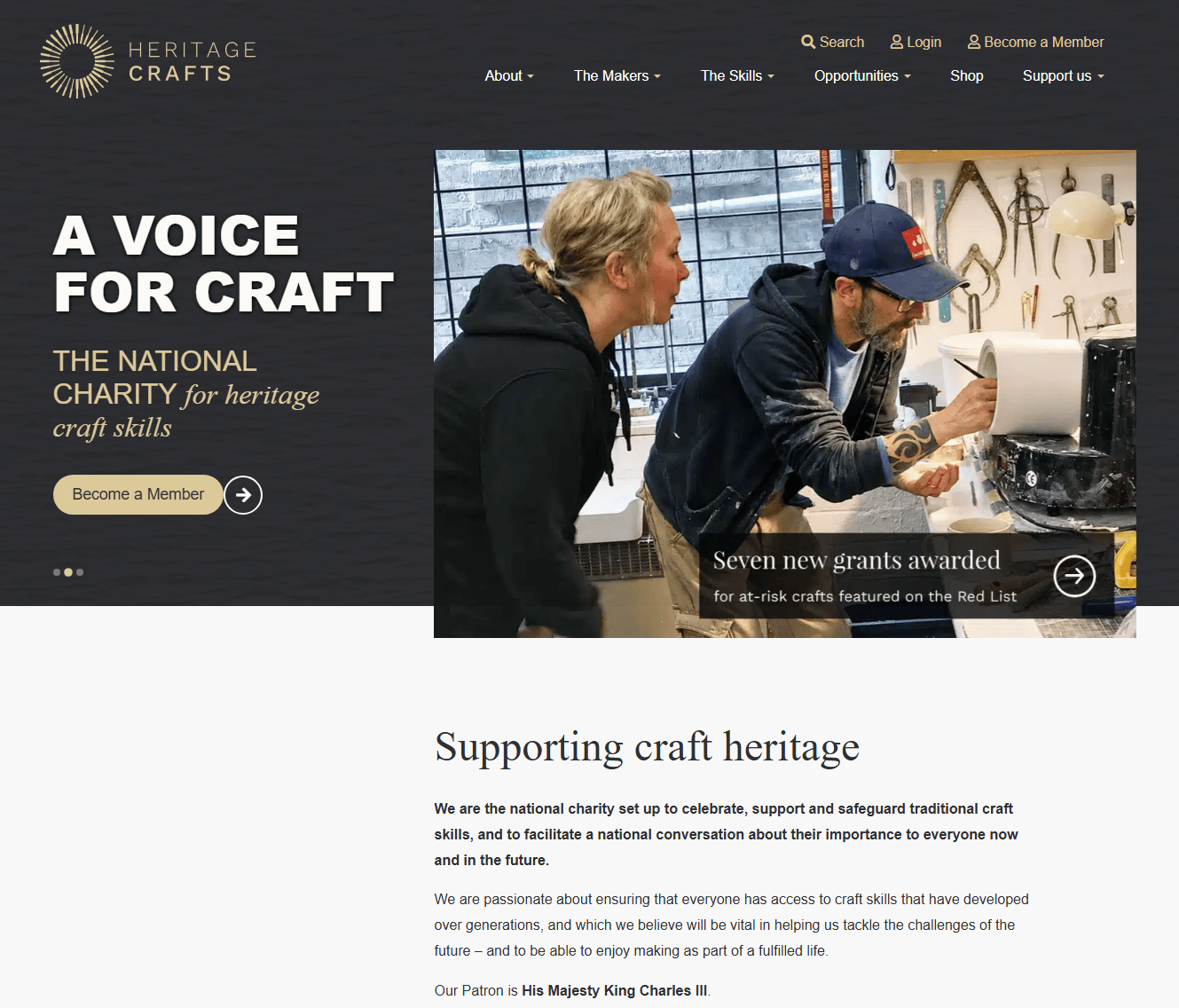
Heritage Crafts has awarded 35 new training bursaries to people learning heritage craft skills around the UK.
Each bursary can provide up to £4,000 towards specialist hands-on training, and they follow another 19 bursaries awarded earlier in the year.
What makes the list particularly enjoyable is the sheer variety of skills involved.
One recipient, John Allison, is developing leatherworking and repair skills through saddlery training. Other bursaries support disciplines that depend heavily on exactly the kind of specialist one-to-one teaching that is difficult to replace once it disappears.
And I think that is worth celebrating.
When we hear that a craft is endangered, it can sound slightly abstract — as though the craft itself is some rare species wandering around waiting to be rescued.
In reality, a craft survives because people know how to do it.
Give another person enough time with somebody who possesses that knowledge, and suddenly the chain gets one generation longer.
That may not produce a dramatic headline.
But thirty-five new links in that chain sounds like rather good news to me.
Goldsmiths’ Fair puts the maker behind the jewellery
This fortnight has also brought one of Britain’s major showcases of contemporary jewellery and silversmithing back to London.
Goldsmiths’ Fair opened its first week on 22 September at Goldsmiths’ Hall, with the second week beginning on 29 September.
Across the two weeks, 138 jewellers and silversmiths are exhibiting work, including three first-time exhibitors and ten early-career makers supported through the Emerging Business Bursary scheme.
What appeals to me about the format is that visitors aren’t simply looking at finished jewellery in display cases.
The fair is specifically designed to allow people to meet the makers, discuss their skills and processes and buy directly from them.
That feels like another recurring thread in these roundups.
The finished object is only half the story.
Once you understand who made something, how long they have spent learning the technique and why they chose one process rather than another, the object becomes much more interesting.
Goldsmiths’ Fair continues from 29 September to 4 October.
Around the craft world
Woodcraft has been getting some welcome attention in Bristol, where Connections Through Wood opened at Centrespace on 18 September.
The exhibition brings together furniture makers, green woodworkers and sculptors using locally sourced timber, deliberately exploring the point where functional woodworking begins to become sculpture. It includes both established makers and younger award-winning craftspeople and continues until 30 September.
In Glasgow, the Scottish Glass Society’s annual exhibition, Connections, ran from 16 to 23 September. The work ranged from stained and fused glass to casting, sculpture and mixed media, accompanied by live stained-glass demonstrations.
And in Edinburgh this weekend, an unusually accessible glimpse into two endangered crafts came through Doors Open Days.
Welby & Wright Tileworks opened its normally private workshop to the public on 26 and 27 September. The studio specialises in handmade encaustic tiles and mosaics, combining historic manufacturing methods with contemporary design and restoration. Visitors could see the materials, tools and processes used by encaustic tile maker Craig Peebles and mosaicist Andrew Little, both QEST Scholars.
Meanwhile, more than 50 artists and craft makers across rural Stirlingshire opened their studios between 19 and 27 September, covering pottery, weaving, basketry, jewellery, mosaics, blacksmithing, stitching and more.
And if your preferred craft involves thread rather than metal, glass or wood, the Royal School of Needlework has announced its new Spring/Summer 2027 short-course programme. The new collection covers a range of embroidery techniques taught both online and at Hampton Court Palace, with public booking opening on 3 October.
From new machines to old knowledge
There is a slightly odd symmetry to this fortnight.
At one end, Cricut has introduced a machine designed to make a creative process more automatic: print it, laminate it and cut it without moving the project elsewhere.
At the other, organisations are fighting to preserve courses precisely because some creative processes cannot easily be automated or condensed.
I don’t think those things are contradictory.
Craft has always adopted tools that remove unnecessary work. Few of us are campaigning for the return of blunt scissors purely because they make cutting more difficult.
The interesting question is what happens to the time that technology saves us.
Perhaps we use it to make more.
Perhaps we use it to learn something more difficult.
Perhaps somebody who starts by pressing a button to make a sticker eventually wonders how letterpress works, how paper is made, how an enamelled surface is created or why one piece of wood behaves differently from another.
There is room in the craft world for both convenience and mastery.
But mastery requires something convenience doesn’t:
somebody who knows enough to teach the next person.
And this fortnight has provided a useful reminder that we shouldn’t take those people — or the places where they teach — for granted.
Share the love!
If you find this post fun, entertaining or useful, please do consider sharing it to your fave social platform using the handy buttons below.
Also, if you are feeling flush, a coffee wouldn’t go amiss! *cheeky wink.


Ok, that’s it for this post. I hope that you have enjoyed your time here today and will subscribe to my email newsletter so that you can hear about future posts.
If have not already done so, please feel free to pop your email address in the box below and I will add you to the list (you can unsubscribe at anytime in the future if I bore you with too many).
In the meantime, thanks for stopping by and I look forward to seeing you next time!
Much love,
John.

