
Every fortnight, I take a wander around the wider craft world to see what has been happening beyond my own particular collection of paper, card, cutting machines and things I really ought to have put away by now.
And this fortnight has produced a rather interesting contrast.
At one end of the creative spectrum, Cricut has introduced a new AI tool that allows people to design cutting-machine projects simply by describing what they want to make. At the other, one of Britain’s endangered textile crafts is attracting a new generation of makers who are discovering the pleasures of doing things very slowly indeed.
Elsewhere, an experimental glassmaker has won a substantial award for turning discarded materials into something beautiful, fashion companies are encouraging people to repair and make their own clothes, and there have been some interesting developments in sewing, papercraft and contemporary textile art.
So, let’s see what’s been happening.
Cricut introduces an AI designer you can talk to
The biggest digital crafting news this fortnight comes from Cricut, which announced a new feature called AI Project Designer on 7 October.
And this is rather more ambitious than simply generating another decorative image.
The new tool sits inside Cricut Design Space and allows users to describe the project they want to make using ordinary language.
Instead of beginning with a blank canvas, selecting shapes, arranging elements and working through the various editing tools, you can explain what you have in mind and ask the software to create a design.
If the first result isn’t quite right, you can continue the conversation, describing what you would like changed.
Cricut says the resulting designs are optimised for its cutting machines and can be taken into the Design Space canvas for further editing before being made. Cricut
Now, I find this interesting for several reasons.
First, it changes the starting point of the creative process.
Traditional design software generally expects you to understand something about the tools before you can produce what you imagine. You might need to know how to create a shape, manipulate a path, arrange layers or combine objects.
A conversational designer attempts to reverse that relationship.
You explain the result you want, and the software works out how to construct it.
At least, that’s the intention.
There are some important limitations.
The initial version supports two-dimensional projects involving a single operation, including labels, decals, gift tags, party decorations and designs for clothing and accessories.
It is not being presented as a complete replacement for every advanced Design Space workflow, and it would be premature to assume it can successfully generate complicated multi-layered or mechanically intricate projects.
There’s also the question of cost.
AI Project Designer is available for all Design Space users to try, but it operates using AI Credits.
People using the free version of Design Space receive a one-time allocation. Cricut Access subscribers receive monthly credits according to their subscription, and generating or regenerating a design uses a credit. Unused monthly credits do not roll over. Cricut
So although the feature may make designing more accessible, regular use introduces another consideration: how many attempts might it take to get something you’re happy with?
That matters because designing is rarely a straight line between an idea and a finished result.
Sometimes the first attempt is wrong.
Sometimes the fifth attempt is wrong.
And sometimes you discover that the thing you originally wanted isn’t actually the thing you want to make after all.
I also wonder what this means for learning design skills.
If a machine can generate a perfectly serviceable birthday-card decoration from a sentence, perhaps fewer people will feel the need to learn how to construct that design themselves.
On the other hand, somebody who previously found Design Space intimidating might finally have a way into creating their own projects.
Neither outcome is inevitable.
For now, this is a significant development in how Cricut expects people to interact with its software.
We’ve already seen AI-generated imagery becoming more integrated into Design Space. AI Project Designer takes that further by attempting to turn a written idea into an actual cutting-machine project.
I’ll be particularly interested to see how reliably it handles practical considerations such as small details, cutting complexity and the difference between something that looks attractive on a screen and something that can actually be made.
Because, as every cutting-machine owner eventually discovers, those are not always the same thing.
You can read the full details in Cricut’s official announcement.

Is lacemaking making a comeback?
From artificial intelligence to something requiring a rather different kind of patience.
Two national newspaper features published during the first week of October have highlighted a renewed interest in bobbin lacemaking, particularly among younger people.
The traditional technique involves twisting and crossing threads wound onto small bobbins, with pins holding the developing pattern in position.
It’s intricate, mathematical and surprisingly versatile.
It’s also a craft whose future has been causing concern.
According to Heritage Crafts, the number of skilled bobbin lacemakers has declined by approximately 30% since its Red List research began. The organisation identifies an ageing practitioner population and a shortage of training opportunities as particular threats.
However, there are encouraging signs.
An article published by The Times on 5 October described young lacemakers introducing the craft to new audiences through social media and workshops.
Among them is Florian Barrows, whose online videos have attracted considerable attention and who is now helping others discover the technique.
Meanwhile, a 6 October feature in the Financial Times explored the work of groups including London Lace Club, founded by Lauren Watson and Amelia White, alongside similar initiatives in North America. The Times
What interests me is that this isn’t necessarily about people wanting to reproduce the same lace their grandparents might have made.
Some are approaching it as textile art. Others are exploring contemporary patterns, unusual materials or simply enjoying the slow, repetitive process of constructing something beautiful.
And that last point is rather important.
We often talk about making crafts easier, quicker and more convenient.
Yet here is a technique attracting attention precisely because it requires concentration, physical involvement and time.
There is something rather satisfying about that.
Meanwhile, Scotland celebrates 150 years of lace-making innovation
The renewed interest in handmade lace coincided with a major celebration of another part of Britain’s lace heritage.
From 7 to 10 October, the towns of Darvel, Newmilns and Galston came together for the inaugural Irvine Valley Lace Festival.
The event marked 150 years since Alexander Morton introduced powered lace production to the area in 1876.
At its height, the Irvine Valley supported around forty factories. Today, two working mills continue that industrial tradition.
The festival included historic lace exhibitions, demonstrations, factory visits and workshops, including opportunities to combine locally produced lace with pottery decoration. Love Newmilns
It’s important to distinguish the two stories.
The Scottish festival celebrated a tradition of machine-produced lace, while the younger makers attracting national attention are helping revive handmade bobbin lace.
They are different disciplines, with different tools and histories.
But they share a common problem: specialist knowledge only survives if somebody continues to use it.
And I rather like the coincidence.
In one part of Britain, communities are celebrating 150 years of industrial textile innovation.
Elsewhere, young people are discovering a centuries-old hand technique and deciding it might have a place in their lives after all.
Perhaps the future of traditional craft doesn’t depend on persuading people to preserve the past exactly as it was.
Perhaps it depends on giving them a reason to make something with it today.
Further reading: Heritage Crafts’ bobbin lacemaking research and the Irvine Valley Lace Festival programme.
A £25,000 award for glass made from unexpected materials
One of my favourite discoveries this fortnight comes from contemporary glassmaking.
On 8 October, glass artist and material researcher Lulu Harrison was announced as the winner of the QEST Sanderson Rising Star Craft Award.
The award includes £25,000 to support the development of her work.
And her approach to glassmaking is rather fascinating.
Harrison combines traditional glassmaking knowledge with experimental materials research, exploring how locally available resources and discarded materials might be used to produce glass.
One particularly interesting aspect of her practice involves waste from the fishing industry.
Having previously lived in Cornwall, Harrison began investigating materials associated with local fishing communities, including shells.
That led her towards traditional glassmaking practices that use calcium-rich materials derived from shells as part of the glassmaking process. Wallpaper*
This isn’t simply a case of throwing rubbish into a furnace and hoping something attractive comes out.
Glassmaking depends on understanding the behaviour of its ingredients and the temperatures and processes required to transform them.
Changing those ingredients can change the properties of the resulting glass.
What Harrison is exploring is how older knowledge about materials might help create new approaches to making.
And I think that is an especially interesting form of innovation.
We often assume that progress means inventing an entirely new technology.
Sometimes it means rediscovering why people used particular materials in the past, then applying that understanding to a problem we face today.
Harrison’s work also raises a wider question about sustainability in craft.
Rather than treating waste simply as something to dispose of, could we become better at recognising it as a potential material?
Of course, that doesn’t automatically make every experimental process environmentally beneficial. Energy use, processing and material sourcing still matter.
But the underlying curiosity is exactly the sort of thing that makes craft research exciting.
The award’s judges praised Harrison’s combination of technical skill, sustainability research and commitment to keeping specialist knowledge alive.
You can read more about her work in Wallpaper’s feature on the award.
Fashion brands discover that customers want to make things themselves
There is also an interesting development in the relationship between fashion and home crafting.
An article published by Vogue Business on 1 October explored the growing interest in knitting, sewing, clothing repair and upcycling — and how some fashion companies are responding.
According to figures supplied to the publication by TikTok, videos using #CraftTok increased by 60% globally over the previous twelve months, while #SewingTok videos increased by 90%.
Those are platform-reported figures rather than an independent measurement of how many people are crafting, but they certainly suggest growing online attention. Vogue
More interestingly, some clothing companies are beginning to treat people’s desire to make and repair things as an opportunity rather than a threat.
On 1 October, Levi Strauss & Co. expanded its Wear Longer Project into Europe.
The initiative provides resources and practical education designed to help younger people repair and personalise their clothes.
That includes skills such as sewing on buttons, patching holes and repairing hems.
The company’s research suggests that younger consumers are interested in keeping clothes longer but may lack some of the practical skills needed to repair them.
Elsewhere, fashion brands are selling patterns, materials and kits that allow customers to make their own versions of garments.
Northern Irish knitwear designer Hope Macaulay, for example, has developed a separate yarn and pattern business alongside her finished knitwear.
French fashion company Promod has also been developing a range of fabrics, patterns and kits, including materials originating from its clothing production. Vogue
Now, none of this means the fashion industry has suddenly decided that everybody should stop buying clothes.
There are commercial reasons for these initiatives, and we shouldn’t pretend otherwise.
But I think there is something encouraging about businesses recognising that people don’t always want to be passive consumers.
Sometimes they want to understand how something is made.
Sometimes they want to repair it.
And sometimes they would rather spend several evenings making their own version than buy the finished article.
That last point will probably sound perfectly reasonable to anyone who has ever spent three weeks making something they could have bought for £12.
The money isn’t necessarily the point.
The making is.
Around the Craft World
A few other developments deserve a mention this fortnight.
Janome refreshes its sewing-machine range
Janome UK has announced updated limited-edition versions of its 230DC and 360DC computerised sewing machines.
The revised models include an easier bobbin-loading arrangement and a sensor designed to prevent stitching when the presser foot hasn’t been lowered. The 360DC Limited Edition also includes an automatic thread-cutting button.
The company has also announced improvements to its Atelier range, including additional features on the Atelier 8 aimed at free-motion quilting and sewing over thicker materials. Janome
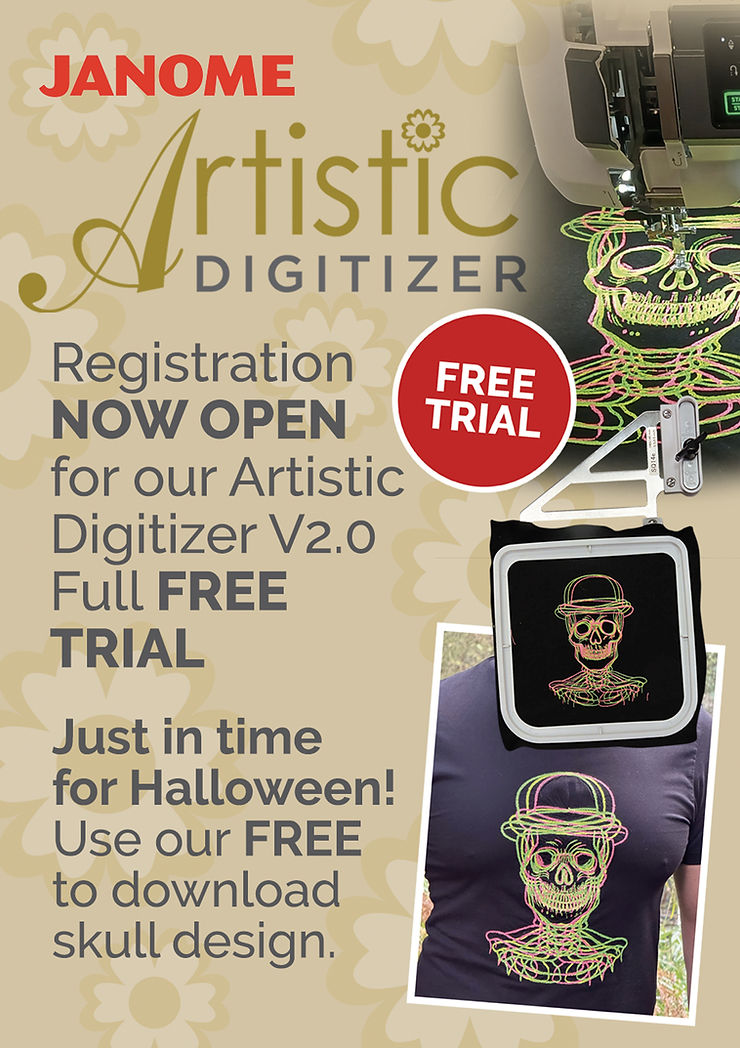
And for anyone interested in machine embroidery, Janome is offering UK residents a free trial of Artistic Digitizer V2.0 software until 31 October. Registration closes on 26 October. Free trial details
Knit + Stitch returned to Alexandra Palace
One of the UK’s major textile-crafting events took place in London from 8 to 11 October.
Knit + Stitch, formerly known as The Knitting & Stitching Show, brought together more than 300 specialist suppliers alongside workshops, demonstrations and textile-art exhibitions.
It’s another reminder of how broad textile crafting has become, with everything from traditional knitting and embroidery to experimental textile art sharing the same event. Alexandra Palace event information
Watercolour paintings become enormous tapestries
A new exhibition at London’s Garden Museum opened on 9 October, featuring three large-scale handwoven tapestries created by artist Clare Woods in collaboration with Edinburgh’s Dovecot Studios.
Called Threads of Ascent, the exhibition transforms small watercolour paintings of climbing weeds into monumental woven artworks.
The original subjects include bindweed growing around industrial fencing and plants reclaiming abandoned spaces.
It’s a lovely example of one artistic medium being translated into another, with the change of scale and material becoming part of the finished work.
The exhibition continues until 5 November and admission is free. Threads of Ascent — Garden Museum
Funding available for endangered crafts
Heritage Crafts is accepting applications for its Endangered Crafts Fund, with grants of up to £2,500 available to support crafts listed as endangered or critically endangered.
Projects can include specialist training, equipment, developing teaching resources and finding ways to make threatened skills more sustainable.
The deadline is 5pm on Friday 16 October, so this is a particularly timely opportunity for anyone working in an eligible discipline. Heritage Crafts
New papercraft releases from Altenew
Papercraft manufacturer Altenew launched its October collection on 7 October.
Alongside new floral stamps and layering dies, the range includes small reusable sticky positioning mats designed to help hold paper and stencils in place during stamping and ink blending.
There are also new storage albums for finished handmade cards.
None of these products represents a major technological change, but they illustrate an ongoing interest in tools that make the practical business of papercrafting a little easier.
Sometimes a useful improvement doesn’t need a motor, a touchscreen or artificial intelligence.
A sticky mat will do nicely.
A craft world moving in two directions at once
Looking back over this fortnight, I keep returning to the contrast between Cricut’s AI designer and the renewed interest in lacemaking.
One promises to make designing easier by removing some of the technical steps between an idea and a finished project.
The other attracts people because it involves learning a demanding physical skill and spending time practising it.
At first glance, those might seem like opposite directions.
But perhaps they’re simply two expressions of the same thing.
Some people want technology to help them make things they couldn’t otherwise make.
Others want to experience the satisfaction of mastering the process themselves.
And plenty of us probably want both, depending on what we’re making and how much patience we have left that afternoon.
What I find encouraging is that neither approach appears to be disappearing.
We’re developing new ways to create, while rediscovering techniques that have existed for generations.
And somewhere between an AI-generated cutting file, a handmade piece of lace and a glass vessel produced from discarded shells, there’s a rather wonderful amount of creative possibility.
I wonder what the next fortnight will bring.
Share the love!
If you find this post fun, entertaining or useful, please do consider sharing it to your fave social platform using the handy buttons below.
Also, if you are feeling flush, a coffee wouldn’t go amiss! *cheeky wink.


Ok, that’s it for this post. I hope that you have enjoyed your time here today and will subscribe to my email newsletter so that you can hear about future posts.
If have not already done so, please feel free to pop your email address in the box below and I will add you to the list (you can unsubscribe at anytime in the future if I bore you with too many).
In the meantime, thanks for stopping by and I look forward to seeing you next time!
Much love,
John.

