
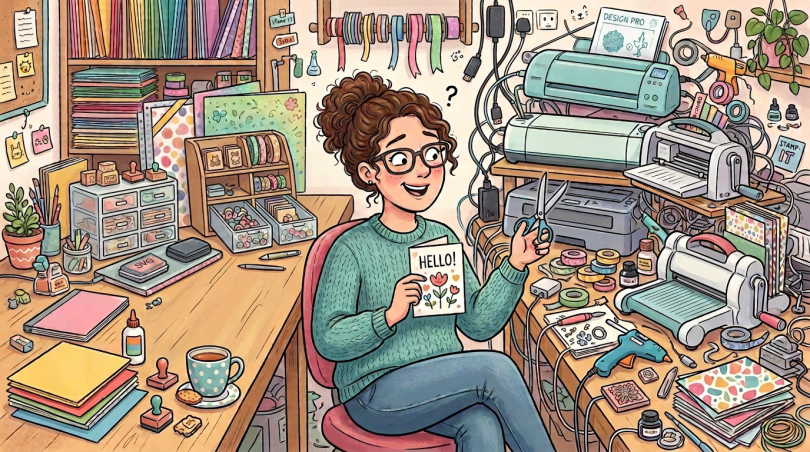
Once upon a time, all we needed was paper, scissors and glue. Now, apparently, we need a firmware update.
I’ve got a question for you. A rather important one, actually, and one that might just get me into a spot of bother.
When did crafting become so blooming complicated?
Seriously. When did it happen?
I’m sure there was a time when you could make a perfectly respectable birthday card with a folded piece of cardstock, a pair of scissors, a bit of glue and perhaps a rubber stamp if you were feeling particularly fancy.
You’d spend a happy afternoon cutting things out, sticking things down, getting glitter in places where glitter really shouldn’t be, and eventually producing something that was unmistakably handmade.
And you know what? It was lovely.
These days, you can find yourself sitting in front of a computer, downloading software updates, adjusting blade pressures, recalibrating cutting mats and wondering why the machine you’ve spent several hundred pounds on has suddenly decided it doesn’t want to talk to your laptop.
All because you wanted to make Auntie Margaret a birthday card.
Poor Auntie Margaret. She only wanted a card with some flowers on it.
Now, before anybody gets the wrong idea, I’m not suggesting we all throw our cutting machines out of the window and return to the dark ages of blunt scissors and glue sticks that dried out approximately eleven seconds after opening them.
Far from it. I love modern crafting technology.
In fact, and this is where things become slightly embarrassing, I might have played a small part in making crafting more complicated myself.
Oh dear.
A Confession Before We Go Any Further
Right. I suppose I’d better get this out of the way before somebody does it for me.
I’ve spent a considerable amount of my working life encouraging people to embrace modern crafting technology. I’ve worked extensively with Cricut and Brother ScanNCut machines, showing people how to use these marvellous contraptions to cut, draw, score and generally perform all manner of creative wizardry.
I’ve also worked as a television producer at Create and Craft, where showcasing exciting new products, techniques and equipment was very much part of the job.
So, having spent years enthusiastically demonstrating increasingly sophisticated ways of cutting up bits of paper, I now find myself sitting here wondering whether we’ve all made things a little more complicated than they need to be.
The irony isn’t lost on me.
Somewhere out there, somebody might be watching one of my old tutorials, trying to work out why they need fourteen different settings to cut out a circle, while I’m sitting here suggesting they could probably manage it with a pair of scissors.
In my defence, I was terribly enthusiastic at the time.
Still am, actually.
And therein lies the problem.
You see, I’m certainly not claiming responsibility for transforming the entire craft industry. Good grief, can you imagine the size of my ego if I did? But I have played my own small part in encouraging people to explore increasingly clever equipment and techniques, so it would be a bit rich of me to stand on the sidelines now, shaking my head disapprovingly.
And I wouldn’t change those experiences for anything. I’ve seen people achieve extraordinary things with these machines, and there’s something genuinely wonderful about watching somebody discover that they can make something they never imagined possible.
But I do wonder whether, in our collective excitement about showing people everything that crafting can involve, we’ve occasionally forgotten to mention that it doesn’t actually have to involve quite so much.
Anyway, confession over. Shall we have a little rummage through the evidence?
The Craft Room That NASA Would Be Proud Of
Let’s start with the equipment.
There was a time when your entire crafting collection might have fitted into a biscuit tin. A fairly substantial biscuit tin, admittedly, probably containing three buttons, some embroidery thread, seventeen mysterious scraps of ribbon and a pencil that hadn’t worked since 1986.
Nowadays, some craft rooms contain more technology than the average office.
We’ve got electronic cutting machines, manual die-cutting machines, embossing machines, hot foiling machines, heat presses, laminators, printers, specialist trimmers and an assortment of other contraptions that require electricity, replacement parts and occasionally a strongly worded conversation.
Some of us have so many machines that we’ve started arranging them according to which ones we actually use and which ones are currently serving as expensive shelving.
And don’t get me started on accessories.
There’s a tool for picking things up, a tool for putting things down, a tool for poking little bits out of other little bits, a tool for cleaning your tools, and probably a specialist tool somewhere for locating the tool you put down thirty seconds ago.
Actually, I’d buy that last one.
My point isn’t that any of these things are unnecessary. Quite a few of them are brilliant, and I wouldn’t want to give mine up.
But I do occasionally look around and wonder how we’ve reached the stage where making a card can require more equipment than fitting a new kitchen.
And the really ridiculous thing?
We’ll spend an absolute fortune on precision tools, sophisticated machines and specialist equipment, then use the back of an old envelope to check whether something fits.
Don’t tell me you’ve never done it.
The Great Glue Situation
Oh, now here’s a subject that could start a small war.
Glue.
Or rather, the extraordinary number of different ways we’ve invented to stick one thing to another.
Once upon a time, you needed to attach a piece of paper to another piece of paper, so you reached for some glue.
Job done.
Now, apparently, we need to consider whether the surface is porous, non-porous, coated, uncoated, textured, glossy, absorbent, flexible or likely to become emotionally distressed during the drying process.
Then there’s the question of whether we want a permanent bond, a temporary bond, a repositionable bond, a dimensional bond or something that could potentially hold the roof on during a hurricane.
We’ve got wet glue, tacky glue, glue pens, glue dots, glue sprays, foam pads, double-sided tape, red liner tape and adhesives with names suggesting they were developed for use on the International Space Station.
And despite owning seventeen different varieties, we’ll still find ourselves standing in front of the adhesive drawer thinking, “Hmm. I’m not sure I’ve got the right glue for this.”
How? HOW?!
I have adhesives that promise to bond virtually any material known to humanity, yet occasionally struggle to persuade two bits of cardstock to remain in the same postcode.
And of course, there’s always that one piece of double-sided tape whose backing paper simply refuses to come off.
You can pick at it with your fingernail, attack it with a craft knife, threaten it with the heat gun and question every decision you’ve ever made in your life.
Nothing.
At that point, the entire project gets put to one side while you go and make a cup of tea.
And quite right too.
Now, before the adhesive enthusiasts descend upon me, I know perfectly well that different glues have different purposes. I’ve used enough of them over the years to understand that.
But perhaps, just occasionally, we might ask whether the little paper flower really needs an adhesive developed using technology borrowed from the aerospace industry.
Or whether a dab of ordinary glue might do the trick.
Controversial, I know.
Do You Need a Dictionary to Make a Birthday Card?
Then there’s the terminology.
Good grief.
Imagine being completely new to crafting and walking into a conversation between two experienced crafters.
“So, I’ve welded the offset, flattened the layers, changed the registration marks and adjusted the kerf, but I think I might need to contour the SVG before I do the kiss cut.”
Pardon?
Are we making a greeting card or preparing to launch a satellite?
And that’s just the digital side of things. We haven’t even started on embossing, debossing, decoupage, matting, layering, masking, blending, foiling, sublimation, quilling, iris folding and all the other lovely things we do.
To those of us who’ve been crafting for years, these words are perfectly normal. We understand them, use them and occasionally throw them into conversations without giving them a second thought.
But to somebody who just wants to make a little something for their friend’s birthday, it must sometimes sound like we’ve invented an entirely new language.
Craftish, perhaps.
Actually, that’s not bad. I might start using that.
The funny thing is, I remember being on the other side of this myself, learning new techniques and trying to make sense of terminology that everybody else seemed to understand.
And I still encounter things I haven’t the foggiest idea about. Usually something involving a new piece of software that has decided to rename a perfectly familiar function for no apparent reason.
So perhaps we could all remember that knowing the terminology doesn’t necessarily make us better crafters.
It just means we’ve memorised a few more complicated ways of describing what we’re doing.
After all, “I’m going to stick this bit on top of that bit” is still a perfectly acceptable explanation in my book.
Another New Product? But I Haven’t Used the Last One Yet!
Ah, yes. The relentless march of the latest must-have crafting product.
Now, I need to tread a little carefully here, because as I’ve already confessed, I’ve worked in an industry where introducing people to exciting new crafting products was very much part of the business.
And new products can be genuinely exciting. I love seeing clever innovations, interesting materials and tools that make previously difficult techniques more accessible.
But goodness me, sometimes I wonder whether we’re being given enough time to actually enjoy the things we’ve already bought.
It feels as though we’ve barely removed the packaging from one exciting new gadget before another appears, promising to revolutionise our crafting experience all over again.
New machine. New accessory. New collection. New colours. New technique. New improved version of the thing that was already described as revolutionary six months ago.
And naturally, we get excited.
“Ooh, look at that!”
“That would be useful!”
“I could make all sorts of things with that!”
And then, six months later, we discover it in a cupboard, still in its original packaging, alongside several other products that were apparently going to change our lives.
Although, in fairness, I think purchasing craft supplies and actually using craft supplies may have become two entirely separate hobbies.
One requires imagination and enthusiasm.
The other requires remembering where you put everything.
I do sometimes worry, though, that the constant excitement surrounding new products can leave people feeling that the equipment they’ve already got is somehow inadequate.
It isn’t.
Your perfectly good cutting machine doesn’t suddenly stop being perfectly good because a newer model has appeared.
Your older stamps don’t become less capable of stamping.
And your collection of beautiful papers doesn’t mysteriously lose its ability to be beautiful because somebody has released another collection with slightly different flowers on it.
Although I appreciate that some of you are now thinking, “Yes, but have you SEEN the new flowers?”
Fair point.
The Pressure to Be Terribly Clever
Here’s another thing I’ve noticed.
Somewhere along the way, I think we’ve started making ourselves feel that every project needs to be a little more impressive than the last.
It’s not enough to make a card. We want to make a card with sixteen layers, moving parts, hidden compartments, battery-operated lights and a mechanism that causes a small paper butterfly to perform a synchronised dance when the recipient opens it.
All very lovely, of course.
But whatever happened to just making a nice card?
Social media probably hasn’t helped. We’re constantly surrounded by beautiful projects, clever techniques and extraordinarily talented people creating things that make our own efforts look rather ordinary by comparison.
You sit down feeling quite pleased with the little project you’ve just finished, have a quick look online and discover that somebody else has created a fully functioning miniature Victorian conservatory out of cardstock.
With working doors.
And lighting.
And a tiny potting shed.
Oh, for goodness’ sake.
Now, I love seeing ambitious projects. I’ve made plenty of complicated things myself, and there’s enormous satisfaction in tackling something that challenges your skills.
But surely there’s also satisfaction in making something simple?
A beautiful stamped image. A lovely arrangement of patterned papers. A little die-cut embellishment positioned just so.
It doesn’t have to move, light up, pop out, spin around or require its own instruction manual.
Sometimes a card can just be a card.
I know. Radical thinking.
When the Hobby Starts Feeling Like Homework
And this is where things get a little more serious. Only a little, mind you. I’ll try not to spoil the mood.
I’ve occasionally heard people talk about feeling overwhelmed by their crafting equipment, particularly when it comes to technology.
They’ve bought a machine because they were excited about what it could do, but then found themselves faced with software, settings, terminology and techniques that weren’t quite as straightforward as they’d hoped.
And instead of enjoying their new purchase, they begin to feel intimidated by it.
Perhaps they leave it alone for a few weeks.
Then a few months.
And eventually it becomes that rather expensive thing sitting in the corner of the craft room, quietly judging them.
Not literally, of course.
Although given the way some machines behave, I wouldn’t put it past them.
And I think that’s a shame, because a hobby that’s supposed to help us relax really shouldn’t leave us feeling as though we’ve failed an examination.
We shouldn’t feel guilty because we haven’t mastered every function of a machine, used every product we’ve bought or learned every technique we see demonstrated online.
There’s no final exam in crafting.
Nobody is going to knock on your door and demand to see evidence that you’ve successfully completed advanced embossing, intermediate colour blending and level-three dimensional construction.
At least, if they do, please let me know.
I’d quite like to see their qualifications.
The thing is, we’re allowed to learn at our own pace. We’re allowed to struggle with something, put it aside and come back to it later. We’re even allowed to decide that a particular technique simply isn’t for us.
There’s no shame in any of that.
And if you bought a sophisticated cutting machine only to discover that you prefer using it for straightforward shapes and lettering, that’s absolutely fine too.
You don’t have to use every feature just because it’s there.
I’ve got an oven with settings I’ve never used, and nobody’s suggested I shouldn’t be allowed to make toast.
Mind You, the Good Old Days Weren’t Always That Good
Now, before we all start getting terribly nostalgic about the simpler days of crafting, I think we should remember that things weren’t always quite as wonderful as our memories suggest.
Yes, we might have managed with fewer tools and gadgets, but some of the jobs we used to do by hand were an absolute nightmare.
Remember cutting intricate shapes out with a craft knife?
One slip and you’d either ruin three hours of work or remove a small but important part of your fingertip.
And if you wanted twenty identical pieces?
Well, that was your afternoon sorted.
Possibly your weekend.
I remember projects where the preparation took so long that by the time everything was cut out, I’d completely lost the enthusiasm to assemble it.
And trying to achieve a perfectly straight cut with a slightly wonky trimmer could result in the sort of language that probably shouldn’t be repeated on a respectable crafting blog.
Assuming this still qualifies as a respectable crafting blog, of course.
Modern equipment has made an enormous difference, and I wouldn’t want to pretend otherwise.
Cutting machines can produce intricate designs with astonishing accuracy. Digital tools allow us to resize, adapt and experiment with designs without wasting half a rainforest in the process. Online tutorials have made learning new techniques more accessible than ever.
And for crafters who find certain physical tasks difficult, modern technology can open up a whole world of creative possibilities.
That’s genuinely worth celebrating.
So no, I don’t want to return to the days when we had to cut everything by hand, when specialist supplies were difficult to find or when the only way to learn a technique was to track down somebody who already knew how to do it.
I rather like living in a world where I can dream up a complicated paper creation and have a machine help me make it.
I just don’t necessarily want to have to dream up a complicated paper creation every time I fancy doing a bit of crafting.
Perhaps We’re Making Things More Difficult Than They Need to Be
And after all that rambling, I think I’ve finally worked out what I’m trying to say.
Perhaps crafting hasn’t actually become too complicated.
Perhaps we’ve simply become so enthusiastic about everything that’s possible that we’ve forgotten we don’t have to do all of it.
We have more choice than ever before. More tools, more materials, more techniques, more inspiration and more opportunities to explore our creativity.
And that’s wonderful.
But having more choice doesn’t mean we have to choose more.
You don’t need three cutting machines, twelve different adhesives and a collection of specialist equipment that requires its own insurance policy to be a proper crafter.
Of course, if you happen to own all those things and enjoy using them, splendid! Carry on.
I’m certainly not about to start confiscating anybody’s craft supplies.
That would be spectacularly hypocritical of me.
And probably quite dangerous.
But equally, if your idea of crafting heaven is sitting at the kitchen table with some pretty papers, a favourite stamp and a cup of tea, then you’re doing it exactly right too.
The same goes for those of us who enjoy a bit of both. One day we might be experimenting with sophisticated digital cutting techniques, and the next we might be happily sticking scraps of paper onto a piece of card because we fancy making something without having to think too hard about it.
Neither approach is better than the other.
And perhaps that’s what we need to remind ourselves occasionally.
Crafting isn’t supposed to be an endless race to master the next technique, purchase the next gadget or create something more elaborate than the last thing we made.
It’s supposed to be something we enjoy.
A way to relax, experiment, express ourselves, learn new skills, make mistakes and occasionally produce something so spectacularly awful that we quietly dismantle it and pretend the whole thing never happened.
We’ve all been there.
Well, I certainly have.
So, Who’s Actually to Blame?
Me, apparently.
Well, partly.
Along with every other enthusiastic crafter, demonstrator, designer, manufacturer, retailer and creative soul who’s ever looked at a perfectly straightforward process and thought, “Ooh, I wonder if we could make that a bit cleverer?”
And do you know what?
I’m not even sure that’s a bad thing.
Curiosity is one of the things that makes crafting so enjoyable. We love discovering new ways to do things, experimenting with ideas and seeing just how far we can push a technique.
Without that curiosity, we’d probably all still be making exactly the same things we made thirty years ago.
Although, come to think of it, I’ve still got some rather lovely projects from thirty years ago that I’d happily make again.
Perhaps that’s the answer.
We don’t need to stop innovating, exploring or embracing new technology.
We just need to remember that there’s nothing wrong with keeping things simple when we want to.
And perhaps those of us who spend our time teaching, demonstrating and sharing creative ideas could occasionally remind people of that too.
Myself included.
Because after years of enthusiastically showing people how to use increasingly clever machines to create increasingly elaborate projects, I think it’s only fair that I occasionally stand up and say:
“You know what? You could probably just use scissors for that.”
Although knowing me, I’ll then spend the next forty-five minutes explaining how to create a perfectly calibrated cutting template for those scissors.
Some habits are difficult to break.
Over to You…
Now, I’d love to hear what you think about all this.
Has crafting become unnecessarily complicated, or are we simply lucky enough to have more creative possibilities than ever before?
Have you ever bought a piece of equipment that promised to make crafting easier, only to discover that you needed a lie-down and a strong cup of tea just to work out how to use it?
Perhaps you’ve deliberately gone back to simpler techniques, or maybe you absolutely love the technology and wouldn’t dream of crafting without it.
And I’d particularly love to hear from those of you who’ve been crafting for decades. What’s the biggest change you’ve noticed, and do you think it’s been for the better?
Do share your thoughts in the comments. I’m genuinely interested in hearing your experiences, and I’m sure we’ll discover that quite a few of us have been having the same thoughts.
Right then. I’m off to make a birthday card.
Nothing complicated. Just a simple little thing with some flowers on it.
Now, where did I put my scissors?
Actually, I could probably do that on the ScanNCut…
Oh, here we go again.
Happy crafting!
Share the love!
If you find this post fun, entertaining or useful, please do consider sharing it to your fave social platform using the handy buttons below.
Also, if you are feeling flush, a coffee wouldn’t go amiss! *cheeky wink.


Ok, that’s it for this post. I hope that you have enjoyed your time here today and will subscribe to my email newsletter so that you can hear about future posts.
If have not already done so, please feel free to pop your email address in the box below and I will add you to the list (you can unsubscribe at anytime in the future if I bore you with too many).
In the meantime, thanks for stopping by and I look forward to seeing you next time!
Much love,
John.


Yes John i agree I have changed broard band and now i have to reregister my scanucut but can,t find my pin no can you help please
LikeLike